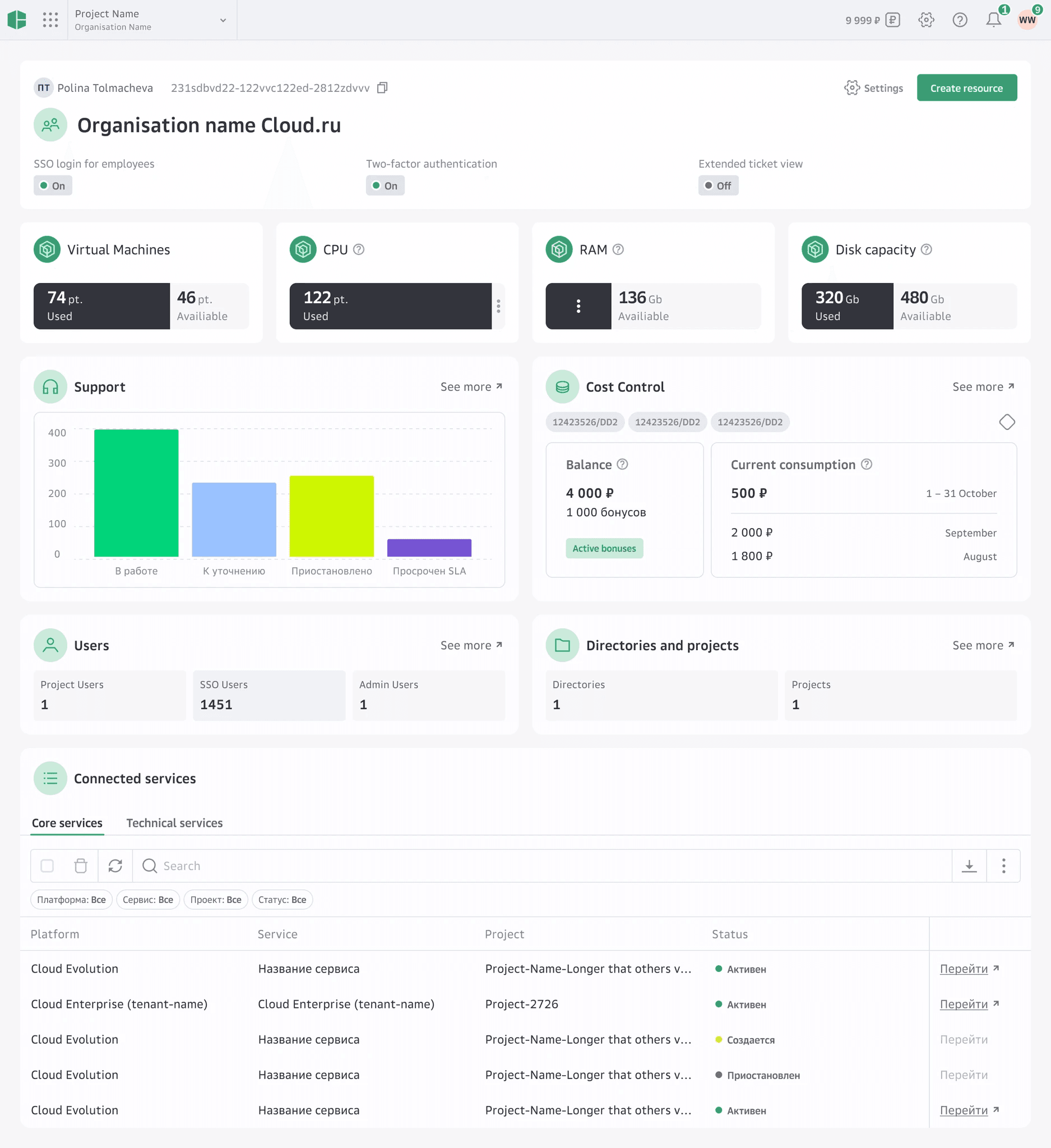
Cloud.ru is the largest cloud provider in Eastern Europe and the #1 vendor on Russia’s IaaS + PaaS market. The portfolio exceeds 100 cloud services running in Tier III data centers, powering GPU‑intensive AI workloads for enterprises and public sector clients. It also operates an 18‑petaflops AI supercomputer (Christofari Neo) dedicated to massive machine‑learning training and inference.
Design challenge: merge four independent platforms (two vendor, two in‑house) into a single user console.
We consolidated all services into a single user console and added cross‑cutting modules: monitoring, billing, and role‑based access control.
We revamped the UX of every service—customer development, friction removal, and migration to a shared design system with tokens and CI/CD pipelines.
I can’t show service screenshots because of NDA restrictions, but here is the list of those most affected by the changes:
Compute & Infra
Compute — on‑demand virtual machines
Bare Metal — dedicated physical servers
Image — catalog of ready‑made OS images
SSH Keys — SSH key management
public IP — public IP addresses
SNAT Gateway — outbound NAT gateway
Load Balancer — traffic load balancing
Magic Router — cloud routing
Storage
Object Storage — S3‑compatible object storage
Networking / Security
DNS — public/private DNS zones
Security Groups — network firewall for VMs and services
Containers & Serverless
Managed Kubernetes — managed Kubernetes cluster
Container Apps — PaaS for containerized applications
Data & Messaging
Managed PostgreSQL — PostgreSQL as a service
Managed Redis — Redis as a service
Managed Kafka — Kafka cluster as a service
Managed Trino — Trino SQL engine as a service
Managed Metastore — centralized metadata storage
Managed ArenadataDB — Greenplum (MPP DB) as a service
Managed Spark — managed Spark clusters
Managed BI — BI servers on subscription
AI & ML
ML Space — full‑cycle ML platform for teams
Notebooks — cloud Jupyter notebooks
ML Inference — hosting and scaling ML/DL models
ML Finetuning — LLM fine‑tuning
Foundation Models — ready‑to‑use LLM/AI models
AI Agents — multi‑agent systems
Managed RAG — turnkey RAG stacks
Governance & Ops
Task History — audit trail of user actions
Tags — end‑to‑end resource tagging